
UO uses an online process for managing course and program changes: The Course Inventory Management software, or CIM (pronounced Kim). CIM is a course inventory and curriculum management platform, with customized online forms and automated workflows, designed to ensure accuracy across our institution’s courses and programs. We use CourseLeaf for both proposing or editing course or program proposals.
By using CIM, which directly feeds into the catalog, approved course or program changes are automatically reflected in the next edition of the UO catalog.
Program Management | Course Management | Catalog (CAT) Management | Catalog FAQ | Core Education Approval Process
Program Management
The Office of the Provost is responsible for coordination and support of academic programming, including the management of procedures for new programs and modifications to curriculum. All proposals for new academic programs and requests for curricular change are subject to review.
In general, there are five potential stages of review: college-level, external review, university-level, Board of Trustees and state-level, regional accreditor (NWCCU). The nature of the proposal will determine which stages of review are required.
To propose a new academic program or to edit an existing program, please log into the Program Management Software with your Duck ID. If you need access, please email your request.
- Learn how to propose a new program by watching this video
- CIM Workflow chart for program proposals
- Propose new program
- Change an existing program out of workflow
- Change an existing program already in workflow
Course Management
Approval of new courses or revisions to existing courses must be approved first at the school/college level and then by the Committee on Courses.
To propose a new course or to edit an existing course, please log into the Course Inventory Management System with your Duck ID. If you need access, please email your request.
- Learn how to propose a new course by watching this video.
- CIM Workflow chart for course proposals
- Propose a new course
- Change an existing course out of workflow
- Change an existing course already in workflow
- CIM Quick-Start Guide
Catalog (CAT) Management
Catalog Deadlines
- Catalog User Editing Opens – mid-March
- Catalog User Editing Closes – April 15
- Catalog Publishing Date – July 1
- Catalog PDF Generation – September 1
Catalog Frequently Asked Questions
What are the key sections I should review when editing my academic department catalog page?
- Overview Tab – Director/Dean information such as name, title, contact information.
- Faculty Tab - The department can update their faculty list in the catalog by either directly editing the faculty tab or providing the updated information to the catalog editor.
- Undergraduate/Graduate Tabs- Ensure that your courses of study are accurate and reflect the proper requirements to students. If changes are necessary, they must be completed with a program proposal at: https://nextcatalog.uoregon.edu/programadmin/Program changes are subject to approval.
What should I do if courses are missing from my course list/tab?
Please contact courseleafsupport@uoregon.edu with the missing subject codes and/or course numbers. We will be able to check the status of the courses in question and correct any listing errors.
How do I update my page after the user editing deadline has passed?
We understand that sometimes information changes or is unavailable until after the user editing deadline has passed. Please contact courseleafsupport@uoregon.edu with your proposed edits. If possible, we will make those updates for you. Be aware that program changes submitted after the deadline are unlikely to be approved in time to make the catalog.
What if I don’t like the layout of my current page?
We are happy to work with you to find a layout that best fits your needs. Please contact courseleafsupport@uoregon.edu to discuss any major overhauls. We ask that you please contact us before making any heavy HTML additions to ensure compatibility with CourseLeaf software.
I believe I should be an assigned editor for a catalog page but it isn’t available to me for editing.
There are a couple possibilities. It is possible that you are currently assigned as an editor but later in the workflow. Many pages have multiple assigned in a sequential order for editing. You will gain access and be prompted for editing when the page has been advanced to your workflow step. You can also contact us at courseleafsupport@uoregon.edu if you feel you are having general access issues.
We need to update our assigned editor workflow due to a staff member leaving/changed roles/etc.
Please contact us at courseleafsupport@uoregon.edu with a request for access to the catalog page in question.
Core Education Approval Process
Overview
The University Senate passed legislation during AY 2017-18 that makes changes to the core (previously “general”) education “Areas of Inquiry” (previously “group-satisfying”) and “Cultural Literacy” (previously “Multicultural”) requirements. Existing courses approved in these categories will be grandfathered in until they are resubmitted for review. Over the next 2 years, all current courses that wish to remain in an Area of Inquiry or be reconsidered for Cultural Literacy will need to be resubmitted. See the Changes to Core Education Group and Multicultural Requirements page for details about what has changed.
Process
***If you are submitting a new or existing course that is seeking approval to meet an Area of Inquiry or Cultural Literacy requirement for the first time, follow the normal course approval process during the academic year.***
Courses that currently meet one of the requirements will be submitted directly to UOCC for summer review. The current review process is on hold due to the Covid-19 pandemic. Courses which already had the a Core Education designation (Area of Inquiry and/or Cultural Literacy) will be grandfathered in until resubmitted and reviewed. We hope to resume review of courses during the summer of 2022 with the final review of courses during summer of 2023. Courses submitted for summer review will be routed directly to the UOCC, bypassing the school/college curriculum review process.
Submission entails completing and submitting the following:
- Complete CourseLeaf form*. Some items on the form are excluded from this process – this annotated PDF indicates which fields need to be filled out and which ones should be skipped. Making any changes other than what is necessary for Core Education reapproval may cause the proposal to be sent back to the school/college curriculum committee.
- An up to date syllabus that matches course description, SEI and what is in templates
- Templates - In the CourseLeaf form, the following statements are to be addressed as evidence that the course meets the new requirements. Please complete the templates found at the link instead of using the text box on the form. In the text box please type “See attached”. You will upload templates at bottom of the CourseLeaf form.
For Areas and Methods of Inquiry:
“Please describe HOW this course has been designed to fulfill the criteria of the core education requirement(s) selected. Please provide specific references to readings and assignments from the syllabus that address the criteria and outcomes for the Area of Inquiry chosen, and the Core Education Methods of Inquiry chosen.”
For Cultural Literacy (US: DIA and Global Perspectives):
“Please describe HOW this course has been designed to fulfill the criteria of the selected category. Please provide specific references to readings and assignments from the syllabus that address the criteria and outcomes for the selected category.”
Access to CourseLeaf and Training
If you need access to CourseLeaf, please contact Carolyn Vogt at carolynv@uoregon.edu
The Office of the Provost will provide trainings during Winter 2020 term for faculty who will be submitting courses for summer 2020 review. Stay tuned for dates.
Ron Bramhall, Associate Vice Provost, and Lee Rumbarger, Assistant Vice Provost, also have some availability to visit department meetings to provide an overview of expectations and the process. Please contact Ron Bramhall for more information.
If you have questions about this process or need additional guidance, contact Ron Bramhall at rcb@uoregon.edu.
The University Senate passed legislation during AY 2017-18 that makes changes to the core (previously “general”) education group (now called “Areas of Inquiry”) and multicultural (now called “Cultural Literacy) requirements. Existing courses approved in these categories will be grandfathered in until they are resubmitted for review. Over the next 2 years, all current courses that wish to remain in an Area of Inquiry (previously “Group-satisfying), or be considered for Cultural Literacy (previously “Multicultural”) areas will need to be resubmitted for consideration. For process details, timeline, and supporting materials, see the Core Education Course Approval Process page. A summary of the changes follows.
Methods of Inquiry
The Senate passed the following mission-based learning outcomes to be addressed in the core education curriculum. The legislation requires that each course that satisfies one of the Areas of Inquiry must also address 2 Methods of Inquiry, and at least half of the criteria for each Method of Inquiry.
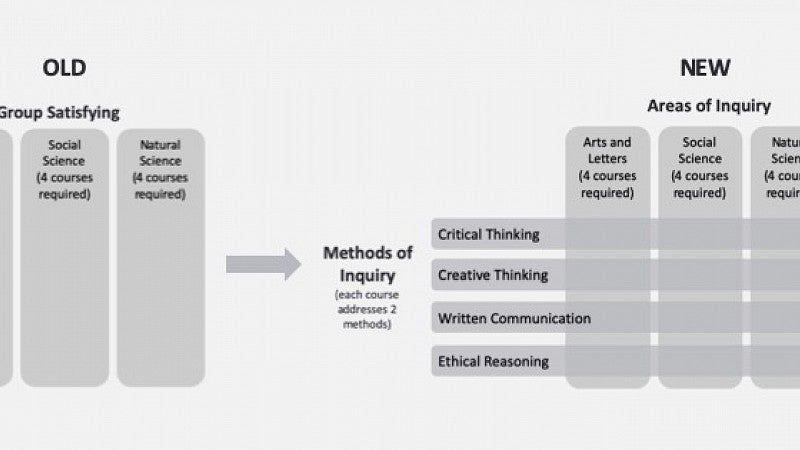
1. Critical Thinking
Students will develop the skills and habits of mind necessary for the comprehensive exploration of issues, ideas, artifacts, and events in the evaluation and formulation of opinions and conclusions. Critical thinking requires students to question critically, think logically and reason effectively in the context of discipline-specific methodologies.
- Explanation of issues, assumptions, or hypotheses
- Using relevant and credible evidence, information, or hypotheses to describe, investigate or analyze a situation, or draw a conclusion.
- Facility with methods of reasoning appropriate to the discipline (such as inductive, deductive, scientific, or esthetic reasoning, or statistical inference)
- Modeling: Capturing the essentials of a situation in language or symbolism suitable for deriving conclusions about it.
- Influence of context and assumptions
- Logical conclusions and related outcomes (implications and consequences)
2. Creative Thinking
Students will develop the capacity to combine or synthesize existing ideas, images, or expertise in original ways, and work in an imaginative way characterized by a high degree of innovation, divergent thinking, and risk taking.
- Acquiring Competencies: acquiring strategies and skills within a particular domain.
- Taking Risks: going beyond original parameters of assignment, introducing new materials and forms, tackling controversial topics, advocating unpopular ideas or solutions.
- Solving Problems
- Innovative Thinking: connecting, synthesizing or transforming ideas in discipline-specific ways.
3. Written Communication
Through iterative experiences across the curriculum, students will develop the capacity to develop and express ideas in writing, to work in different genres and styles, work with different writing technologies, and mix texts, data, and images to effectively communicate to different audiences.
- Context of and Purpose for Writing: considerations of audience, purpose, and the circumstances surrounding the writing task(s).
- Content Development
- Genre and Disciplinary Conventions: Formal and informal rules inherent in the expectations for writing in particular forms and/or academic fields
- Sources and Evidence
- Control of Syntax and Mechanics
4. Ethical Reflection
Students will develop the capacity to identify, examine, and critically revise ethical positions, map them onto larger ethical ideas (theoretical traditions, moral frameworks, prevailing social frameworks), and reflect on how decisions and actions (including, sometimes, inaction) shape our relations to others and self. Students will develop the capacity to articulate the ends sought in a range of endeavors in personal, social and professional contexts. Students will also develop concepts, practices, and other tools appropriate to valuing those ends in relation to their means of attainment and their impacts on self and others.
- Awareness of one’s own values and capacities for self-questioning
- Language and tools to examine ethical issues, including discipline-specific frameworks
- Recognition of the presence of ethical issues, especially where typically neglected
- Awareness of impacts of our decisions and actions (both personally and as members of groups)
- Application of ethical inquiry to subject-specific issues
Cultural literacy
The Senate replaced the existing Multicultural Requirement with a Cultural Literacy requirement. Each student will be required to take 1 course in the US: Difference, Inequality and Agency category, and 1 course in the Global Perspectives category. The criteria for each follows.

1. US: Difference, Inequality and Agency (US)
These courses will develop students’ analytical and reflective capacities to help them understand and ethically engage with the ongoing (cultural, economic, political, social, etc.) power imbalances that have shaped and continue to shape the United States. This engagement may also include the relation of the United States to other regions of the world. Each course will include scholarship, cultural production, perspectives, and voices from members of communities historically marginalized by these legacies of inequality.
Each course will undertake one or more of the following:
- Teach respectful listening and tools for ethical dialogue in order to expand students’ abilities to practice civil conversation and engage with deeply felt or controversial issues.
- Facilitate student reflection on their own multiple social identifications and on how those identifications are formed and located in relation to power.
Each course will address each of the following:
- Intersecting aspects of identity such as race, gender, sexuality, socioeconomic status, indigeneity, national origin, religion, or ability.
- The uses of power to classify, rank, and marginalize on the basis of these aspects of identity, as well as considerations of agency on the part of marginalized groups.
- Historical structures, contemporary structures, forms of knowledge, cultural practices, or ideologies that perpetuate or change the distribution of power in society.
2. Global Perspectives (GP)
These courses will foster student encounter with and critical reflection upon cultures, identities, and ways of being in global contexts. Each course will include substantial scholarship, cultural production, perspectives, and voices from members of communities under study, as sources permit.
Each course will undertake one or more of the following:
- Teach respectful listening and civil conversation as critical tools for collective student engagement with topics that are controversial today;
- Provide critical vocabulary and concepts allowing students to engage and discuss topics with which students may be unfamiliar.
Each course will engage with one of more of the following:
- Texts, literature, art, testimonies, practices, or other cultural products that reflect systems of meaning or beliefs beyond the US context;
- Power relations involving different nations, peoples and identity groups, or world regions;
- Consideration of hierarchy, marginality or discrimination based on race, ethnicity, gender, religion, sexual orientation, nationality, or ability (or some combination).
Note: Approved study abroad programs also fulfill the Global Perspectives requirement.